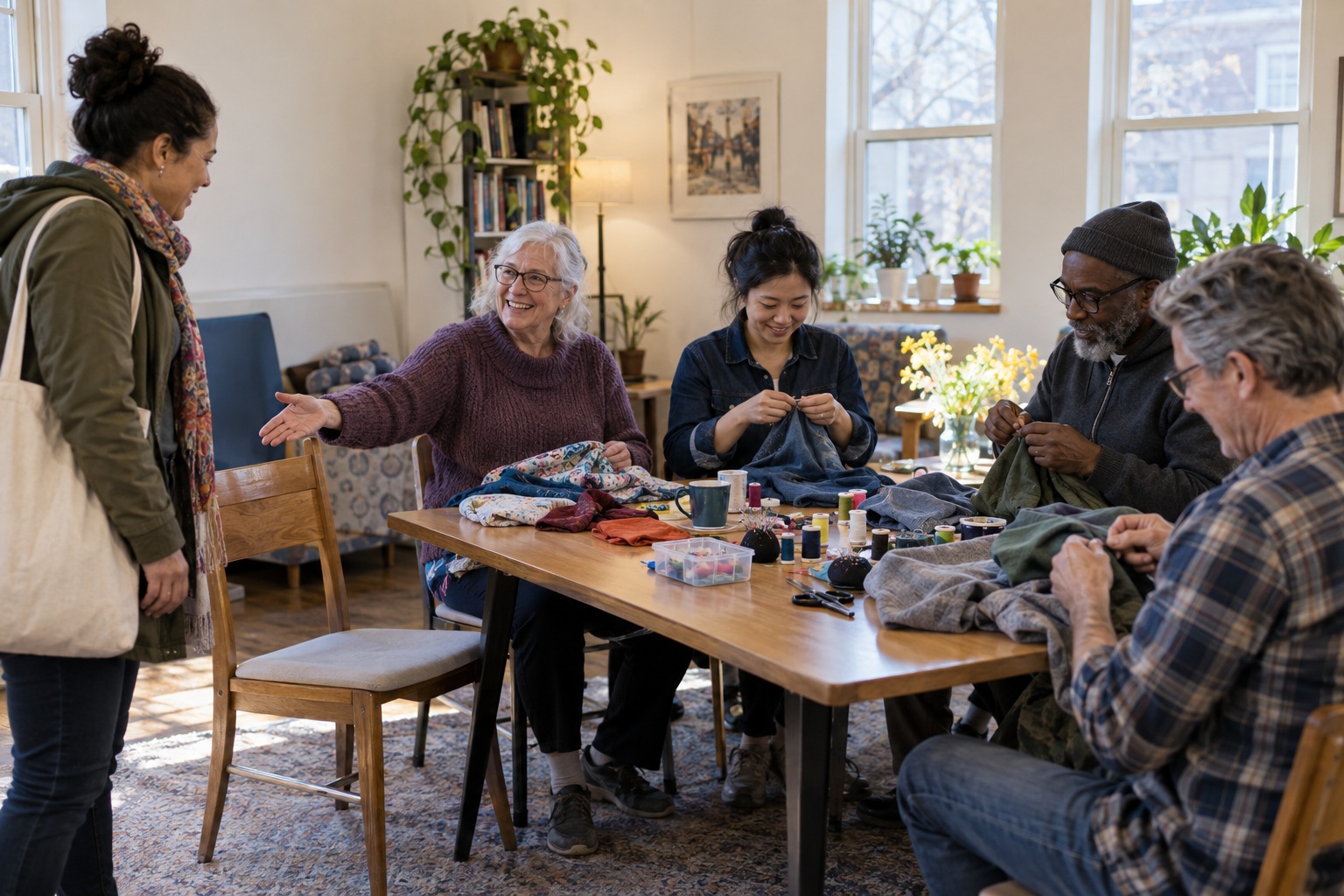
Imagine two neighborhood gatherings with the same room, refreshments, and attendance. At one, established friends talk in a tight circle while newcomers hover by the door. At the other, someone offers each arrival a chair and a small task. The difference is a useful starting point for understanding community events: being allowed to enter and knowing how to participate are separate things.
As a cultural format, the recurring local gathering deserves attention for what it asks of people. A mending table, reading hour, or casual board-game session can offer company without requiring a polished introduction or an expensive evening. Its success depends on how that invitation works in practice.
A shared activity can carry the conversation
“Come and socialize” leaves a newcomer to invent a role. “Bring something small to mend, or come and watch” gives them a place to start. The activity supplies natural questions: what are you making, how does this work, and may I try?
Repair Cafés provide a concrete example. Their organizers describe them as gatherings where visitors work with skilled volunteers on broken belongings, rather than simply dropping items off for a repair service. That distinction makes participation part of the format. The item on the table becomes a reason for people with different backgrounds to spend time together.
This does not prove that every activity creates lasting friendships. It suggests a useful design principle: give people something approachable to do together, while leaving room for conversation and quiet observation.
Make the invitation answer ordinary questions
An event can feel inaccessible before anyone reaches the venue. Unclear costs, missing access information, and vague expectations force prospective visitors to ask whether they belong. A friendly name does little to resolve those practical uncertainties.
A useful invitation explains:
- When the event starts and finishes, and whether arriving late is acceptable.
- Whether booking, payment, equipment, or prior knowledge is required.
- What access arrangements are available and whom to contact about a particular need.
- Whether people may attend alone, observe, or leave before the end.
Be specific about limits as well. A volunteer sewing session should not imply that every repair can be completed. A small reading group should not promise unlimited places. Clear boundaries let people decide whether the event fits their circumstances without having to guess.
Design the first few minutes
For an organizer, the beginning of an event may feel busy but familiar. For a first-time visitor, it is the entire experience so far. Assign someone to welcome arrivals, explain the activity briefly, and show them an available seat.
A welcome need not become a public performance. Asking every newcomer to introduce themselves to a room can be uncomfortable, particularly when they expected a low-pressure visit. Offer a simple choice: join a table, watch for a while, or ask for help getting started.
Consider a hypothetical neighborhood mending afternoon. One table handles beginners’ questions, another provides space for people already working, and a few chairs allow conversation away from concentrated stitching. Those small choices accommodate different levels of confidence without ranking people by skill.
Give regulars something to share
Returning participants can make a gathering welcoming, but they can also unintentionally make it feel closed. Familiar jokes, assumed knowledge, and seats treated as permanently reserved can create an invisible membership system.
Give regulars useful ways to include others: explain a game, offer spare materials, or introduce two people working on similar tasks. Avoid relying on one unusually outgoing host to make every connection. A gathering is easier to sustain when several people can help someone find their place.
Sharing responsibility also includes the less visible work. Setup, cleanup, reminders, and access arrangements need named owners. If the same person handles everything, the event’s apparent ease can conceal an exhausting workload.
Judge the return visit, not just the photograph
A crowded launch offers limited evidence about whether a gathering is comfortable or sustainable. After a few sessions, ask more grounded questions. Could a newcomer join without an introduction? Did anyone feel pressured to spend money? Was there room for a quieter participant? Could the volunteers repeat the event without resentment?
Collect feedback in more than one way. A brief private conversation may reveal something that a public group discussion misses. Then make one or two visible changes and explain them plainly.
The recurring event becomes meaningful through repeated, manageable participation. A clear invitation, a place at the table, and a modest shared task are small arrangements, but they give the next visit something concrete to build on.