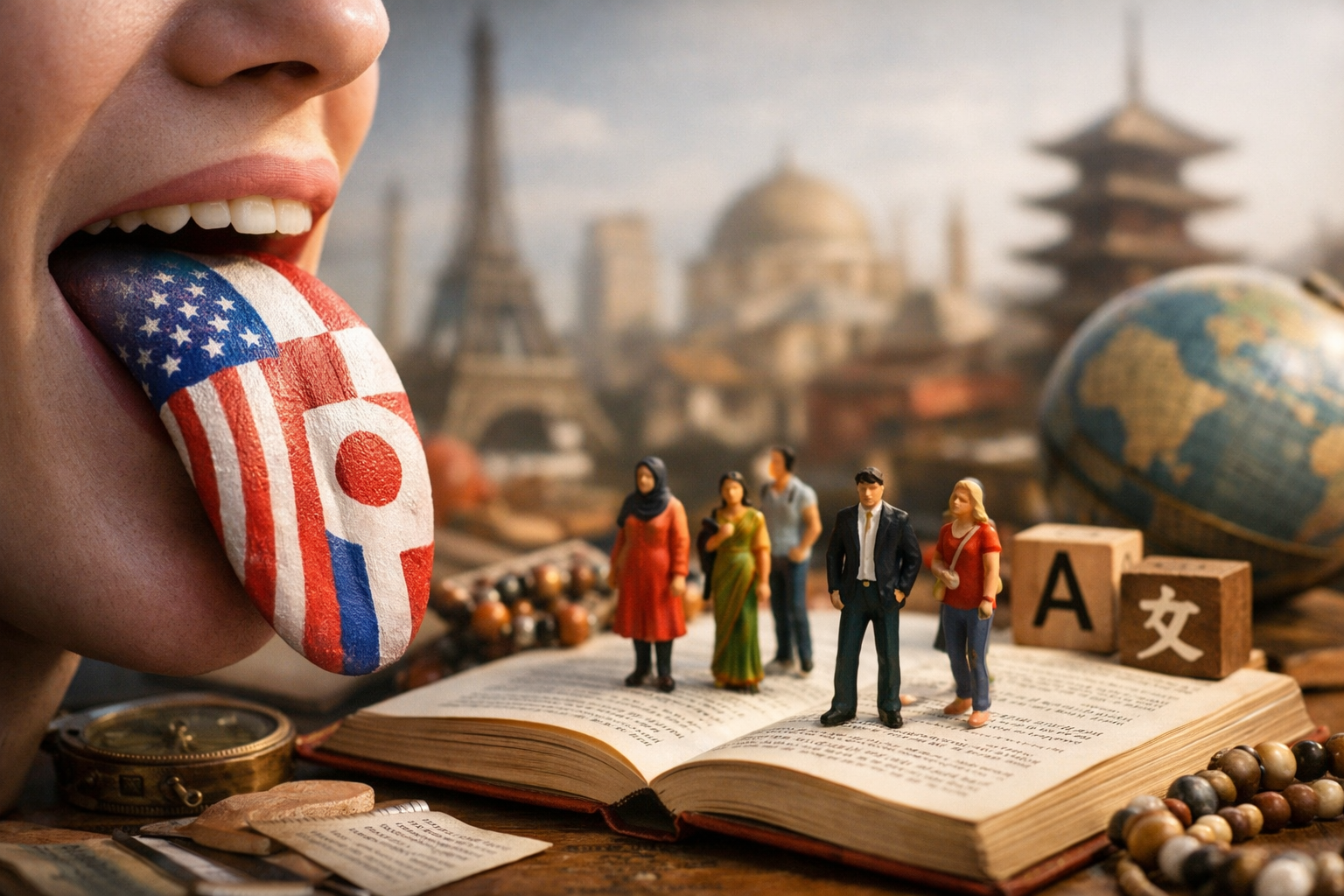
Language as a Social Passport
Language is often described as a vehicle for sharing ideas, but in culture and society it functions more like a passport: it grants access, marks origins, and signals affiliation. The words we choose, the accent we carry, and even the rhythm of our speech can identify where we come from—or where others think we come from. Because of this, language is rarely neutral. It is woven into institutions such as schools, workplaces, and media, where certain varieties are treated as “standard” and others as informal, incorrect, or even suspicious.
Identity emerges in this tension between self-expression and social perception. People do not simply “have” a language; they use it to perform roles—professional, familial, regional, generational—and to navigate belonging. A greeting, a joke, a term of respect, or a slang phrase can all do social work: they can build intimacy, establish authority, create distance, or invite solidarity.
Mother Tongue, Heritage, and Emotional Memory
For many, the first language learned at home is tied to emotional memory: lullabies, family stories, discipline, affection, and humor. This is why heritage languages frequently carry a deep sense of identity even when speakers become less fluent over time. A person might be fully competent in the dominant language of their society but still feel that their “real self” emerges in the language of childhood—particularly when expressing grief, love, or faith.
Yet heritage languages can also become sites of conflict. Second-generation immigrants, for instance, may be judged by relatives for not speaking “well enough,” while simultaneously encountering pressure in school or work to minimize their home language. In these moments, language becomes an arena where authenticity is policed: who counts as a “real” member of a community is sometimes measured by pronunciation and vocabulary rather than shared values or lived experience.
When Language Loss Feels Like Identity Loss
Language shift—when a community gradually adopts a dominant language—can bring economic or educational advantages, but it can also feel like a cultural amputation. When words for local landscapes, traditions, kinship roles, or spiritual concepts disappear, entire ways of interpreting life can become harder to articulate. Revitalization efforts often emphasize that reclaiming a language is not only about grammar; it is about restoring intergenerational ties and strengthening a collective sense of self.
Accents, Dialects, and the Politics of “Standard” Speech
Accents and dialects are among the most immediate identity signals, and they often trigger snap judgments. In many societies, a standardized variety—associated with elite education, state institutions, or national media—becomes the benchmark for “correct” speech. But “standard” does not mean linguistically superior; it usually reflects historical power. Dialects contain complex rules and rich expressive capacities, yet they may be treated as less professional or less intelligent due to social stereotypes.
This creates practical consequences. Hiring decisions, classroom expectations, and customer service interactions can all be influenced by how someone sounds. People who speak a stigmatized dialect may engage in careful self-monitoring, sometimes called “linguistic accommodation,” adjusting pronunciation and vocabulary to match the expectations of different settings. The result is that language becomes labor: managing identity costs time, energy, and emotional resilience.
Code-Switching and Double Consciousness
Code-switching—shifting between languages or language varieties—can be a source of creativity and belonging. It can also reflect the need to survive socially. A speaker may use one register at home, another in public, and another online. This flexibility is a skill, but it can be accompanied by a sense of double consciousness: the feeling of being observed and evaluated, of never fully relaxing into one voice. At its best, code-switching allows people to bridge communities; at its worst, it can be demanded as proof of “fitting in.”
Names, Pronouns, and the Right to Self-Definition
Language shapes identity at the most personal level through names and pronouns. A name carries family history, cultural meaning, and hopes about the future. When institutions mispronounce or “simplify” names, it often communicates that the individual’s identity is inconvenient. Similarly, pronoun use is not merely grammatical; it can validate or erase a person’s gender identity. In both cases, respectful language is a basic recognition of personhood.
These dynamics show that identity is not only internal. It is negotiated in social interaction. The words others use for us—and the terms we insist on for ourselves—are part of ongoing struggles over dignity, legitimacy, and belonging.
Multilingual Societies: Power, Opportunity, and Inequality
In multilingual societies, language can function like currency: some languages are rewarded with status, mobility, and institutional support, while others are restricted to private life or marginalized communities. Governments may promote a national language to unify the population, but the same policy can disadvantage minority language speakers in education, healthcare, and legal settings.
At the same time, multilingualism can be an advantage when it is recognized and supported. When schools treat multilingual students as already skilled communicators—rather than as deficient in the dominant language—students are more likely to thrive. The difference often lies in whether society views multilingualism as a problem to be fixed or as a resource to be cultivated.
- Institutional recognition (translation, bilingual services, multilingual signage) signals that speakers belong.
- Educational support (heritage classes, bilingual programs) protects linguistic diversity and improves learning outcomes.
- Media representation (dialects and minority languages on screen) normalizes varied identities.
Digital Language: Identity in the Age of Algorithms
Online spaces have expanded how identity is performed through language. People signal community membership through memes, abbreviations, emoji-adjacent conventions, and evolving slang. Digital language is fast-moving and often playful, making it a powerful tool for youth identity and subcultural formation. It also enables new forms of multilingual mixing, where speakers blend languages fluidly to reflect hybrid identities.
But digital platforms come with hidden constraints. Algorithms prioritize certain languages and styles of expression, influencing what becomes visible and what is suppressed. Automated moderation and speech recognition systems can misread dialects and minority languages, leading to unequal enforcement or exclusion. In this way, the politics of language now includes the politics of technology: whose speech is legible to machines and whose is treated as noise.
Building More Inclusive Language Cultures
If language is tied to identity, then inclusive societies must treat linguistic diversity as a public good. This does not require everyone to speak the same way; it requires institutions and communities to expand what they consider legitimate speech. Respect for names and pronouns, fair treatment of accents, and support for multilingual services are not symbolic gestures—they shape who feels safe, heard, and able to participate.
Ultimately, language and identity are co-authors of one another. We inherit words from family and history, but we also reinvent them to describe who we are becoming. When societies make room for many voices, they make room for many selves.