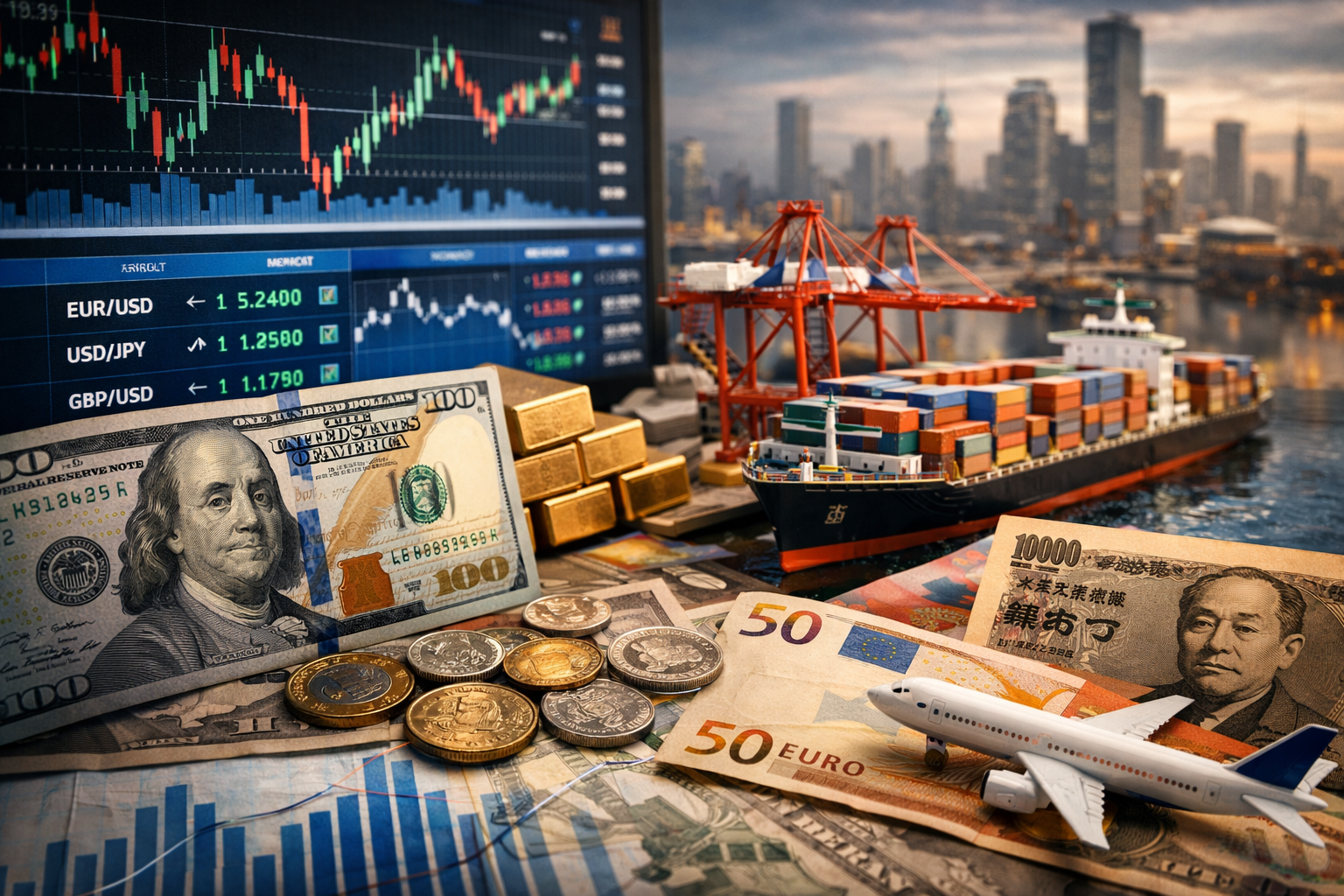
Why Currency Markets Matter
Currency and foreign exchange (forex) sit at the center of modern finance because nearly every cross-border economic activity requires converting one currency into another. When a country imports energy, sells manufactured goods, issues debt to foreign investors, or receives tourism revenue, exchange rates affect the final cost and value. Even if you never trade forex, it influences inflation, mortgage rates, corporate profits, and the prices you pay for goods with global supply chains.
Forex is also the world’s most liquid market, with trading activity distributed across banks, asset managers, corporations, electronic market makers, and increasingly retail platforms. That liquidity makes currency prices responsive to new information—sometimes within seconds—turning exchange rates into a real-time signal of economic expectations.
What Is Forex and How Does It Work?
Forex trading is the exchange of one currency for another, typically quoted as a pair such as EUR/USD or USD/JPY. The first currency is the base, the second is the quote. If EUR/USD is 1.10, it means 1 euro buys 1.10 U.S. dollars.
Unlike centralized stock exchanges, forex is largely an over-the-counter network where prices are formed across multiple venues. Key features include:
- Spot market: Immediate exchange at current market prices (settlement usually occurs within two business days).
- Forwards and swaps: Customized or institutional contracts to exchange currency at a future date, often used for hedging.
- Futures and options: Exchange-traded instruments that provide standardized contracts and, in options, the right (not obligation) to exchange at a set rate.
What Drives Exchange Rates?
Exchange rates move because currencies reflect both a country’s economic fundamentals and global investor risk preferences. While short-term price action can be noisy, the following forces repeatedly matter.
1) Interest Rates and Monetary Policy
Central banks influence short-term interest rates and overall financial conditions. When a country’s yields rise relative to others, its currency may strengthen as investors seek higher returns—especially when the policy shift is seen as credible and sustainable. Expectations are crucial: markets often move on hints of future rate changes rather than the decision itself.
2) Inflation and Purchasing Power
Over time, currencies tend to depreciate when inflation is persistently higher than peers, because domestic purchasing power erodes. The concept of purchasing power parity suggests goods should cost similarly across countries after conversion, but in practice frictions, taxes, transport costs, and services keep currencies away from “fair value” for long periods.
3) Economic Growth and Productivity
Stronger growth can attract investment and support a currency, particularly when it reflects productivity gains rather than debt-fueled demand. However, rapid growth can also widen trade deficits by boosting imports, which may offset currency strength.
4) Trade Balances and Commodity Terms of Trade
Countries that export key commodities (such as oil, metals, or agricultural products) often see their currencies linked to global commodity prices. When export prices rise, trade revenues increase and can support the currency; when they fall, the reverse may occur. For manufacturing exporters, competitiveness and foreign demand can play a similar role.
5) Capital Flows and Risk Sentiment
Global investors shift funds between countries based on risk appetite, political stability, and financial conditions. During periods of stress, “safe-haven” currencies can strengthen as investors seek liquidity and perceived stability. In risk-on periods, higher-yielding or growth-linked currencies may perform better.
6) Politics, Regulation, and Geopolitics
Elections, fiscal policy changes, sanctions, and conflict can move currencies by changing economic expectations or restricting capital flows. Credible institutions and transparent policymaking tend to reduce risk premiums; uncertainty can increase them.
Why Forex Matters to the Real Economy
Exchange rate shifts quickly spill into everyday economic outcomes. The transmission is not always symmetrical or immediate, but several channels are especially important.
Import Prices, Inflation, and Living Costs
When a currency weakens, imported goods and inputs become more expensive in local terms. That can feed into consumer inflation—particularly for energy, food, electronics, and any industry relying on foreign components. Central banks may respond by tightening policy, which can slow growth but help stabilize prices.
Export Competitiveness and Corporate Earnings
A weaker currency can make a country’s exports cheaper abroad, potentially supporting manufacturing and tourism. For multinational firms, currency moves can materially affect reported earnings: revenues earned overseas translate into fewer home-currency units when the domestic currency strengthens, and more when it weakens.
Debt, Financial Stability, and “Original Sin”
Some borrowers—governments and corporations—issue debt in foreign currency when local markets are underdeveloped or borrowing costs are lower. If the domestic currency depreciates, the local-currency cost of servicing that debt rises, increasing default risk and sometimes triggering broader financial stress.
Exchange Rate Regimes: Floating vs. Fixed (and Everything Between)
How a country manages its currency shapes economic flexibility and vulnerability.
- Free-floating: The market sets the rate, and the central bank focuses mainly on inflation and employment. This allows shocks to be absorbed through the exchange rate but can increase volatility.
- Pegged or fixed: The currency is tied to another currency or basket. It can reduce uncertainty for trade and inflation expectations, but it requires reserves and policy discipline to defend the peg.
- Managed float: Authorities intervene occasionally to smooth volatility or guide the currency without a strict fixed target.
Each approach involves trade-offs between monetary policy independence, capital mobility, and exchange rate stability—often described as the “impossible trinity” of international macroeconomics.
How Businesses and Investors Use Forex
Most corporate forex activity is not speculation; it is risk management. A firm that will receive payment in a foreign currency may hedge to protect profit margins, while an importer may hedge to stabilize input costs. Common tools include forward contracts, options for asymmetric protection, and natural hedges (matching foreign revenues with foreign costs).
Investors face currency exposure whenever they hold foreign stocks, bonds, or real assets. Sometimes the currency risk diversifies a portfolio; other times it dominates returns. Choosing whether to hedge depends on investment horizon, interest-rate differentials, and the role of the foreign allocation.
Practical Takeaways for Understanding Currency Moves
- Watch expectations, not just data: Markets often price future policy and growth before it appears in headlines.
- Follow real yields and inflation trends: Interest rates matter most in inflation-adjusted terms.
- Separate short-term noise from long-term forces: Positioning and news can move prices quickly, but fundamentals shape longer arcs.
- Consider balance-sheet effects: Countries and firms with foreign-currency debt are more sensitive to depreciation.
Conclusion
Currency and forex are not niche topics reserved for traders; they are a core mechanism through which economies interact. Exchange rates influence inflation, competitiveness, financial stability, and investment returns. Understanding what drives currencies—rates, inflation, trade, capital flows, and political risk—offers a clearer view of why the economy feels the way it does, from the price of essentials to the performance of global companies.